[postlink]http://america-blogger.blogspot.com/2012/10/frankenstorm-sandy-prompts-monstrous.html[/postlink]
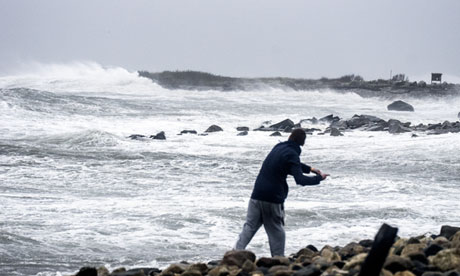
If you were watching CNN, you will have gone to bed wondering whether New York would still be on the map come dawn
Some waves, yesterday.
Amid the hype, the endlessly recycled images on 24-hour news channels
left the viewer unsure of how serious the crisis really was.
Photograph: Ian Maclellan/Demotix/Corbis
After watching media mass hysteria over hurricane Sandy on CNN for a chunk of the evening I went to bed on Monday night uncertain whether New York would still be with us by breakfast time. Yo, Big Apple, glad to wake up and find you very wet but still more or less in one piece.
I'm
not sure about CNN's reputation being intact in our house though. I
don't often watch the channel much these days, but even with Christiane Amanpour
– she's a veteran war correspondent and grownup – in charge of
coverage of "the monster storm from hell", the output was completely
over the top. It's the sort of occasion when the only experts being
consulted sounded like the OTT variety. And, no, little or no climatic
context was provided.
By comparison, BBC1's Six O'Clock News,
which only devoted its first five minutes or so to something that hadn't
actually happened to the US eastern seaboard yet – and didn't live up
to its billing when it did, peaking a few hours later – was a model of
reticence. As ever Radio 4 is both calmer and more informative. All
those misleading pictures often get in the way.
I won't be back on
CNN in a hurry, which is worrying – and not just for CNN either because
intense competition between rival media in search of readers and
viewers leads to hype and hysteria which must put off many customers.
Even those in search of lurid sensation go off in search of even dafter
novelty when they tire of waiting to see if CNN's intrepid reporter in
storm-torn Atlantic City – his name was Ali – would be picked up by the
wind and blown into the sea (or the "literal Niagara Falls" as one
eyewitness called the ocean).
In fairness I should concede that
this has been a very big storm and a pretty serious event: 13 deaths,
flooding in lower Manhattan, loss of power, evacuation of hospitals and
low-lying areas (200,000 New Yorkers live less than four feet above sea
level), the closure (every cloud has a silver lining?) of Wall Street.
Some
60 million people have been affected in the US alone, solemnly warned
by CNN that if they lost their electricity supply, food and medicine in
the fridge might perish! I tell you, it's hell out there in the freezer
section.
It's also right that the authorities should persuade
those seriously at risk to take that risk seriously, not least because
officialdom knows it will be blamed anyway. Be sensible, stay indoors.
People who normally lead safe lives are often not good at risk
assessment – they worry about the wrong thing.
As Jonathan Watts reports on the Guardian's storm live blog,
69 people died when Sandy devastated the Caribbean, and Haiti was badly
hit as usual. Alas, there are few global media corporations or foreign
correspondents in Port-au-Prince, less medicine in the fridge too, so it
made less of an impact. But Sandy has already been around for 10 days.
We
all understand how these things work. Extreme weather makes for great
TV pictures. There's even a dedicated weather channel out there
somewhere, where you can watch hurricanes
or snow storms all day if you like. The same pictures of storm-lashed
harbours (or if it were riots then burning buildings) come round time
after time. Only the dramatic pics are shown. One ends up unsure how
serious a crisis has really been.
Not everyone sounded as if the
end of the world was at hand. Bloomberg News seemed calmer. Mayor Mike
Bloomberg (they are related) of New York was a model of calm, as Rudolph
Giuliani was in New York's real trauma, the 9/11 attacks – a benchmark event that should have helped provide the city with perspective.
Mitt
Romney and Barack Obama both cancelled campaign events. The president
returned to the White House and said all the right things. But he looked
tired and sounded disengaged. Obama doesn't do empathy well. He was
almost as hopeless as his Republican challenger safely above high tide
in the mid-west.
Since Romney wants to abolish the Federal Emergency Management Agency
and leave things to individual states, there may be some advantage for
Obama here. He still believes federal government can make a difference.
One word – Katrina – the hurricane that devastated New Orleans in 2005
when warnings were ignored at local, state and federal level, suggests
they need better government to take strategic precautions.
Talking
of which, the one phrase I didn't once hear on CNN last night – or on
the BBC – was "climate change". In other words, context, the big
picture. Climate, not mere weather. Was the scale of hurricane Sandy the
product of a warming planet? Some experts say it's a contributory
factor.
I don't know the answer. That's way beyond my pay scale.
What the telly boffins were saying was that its 1,000-mile size was the
result of three specific weather events colliding: a traditional
Caribbean hurricane, cold air coming down from the north and a high
pressure system whose contribution the A-level geographer in me didn't
quite understand.
Consulting Google College ("we never close") this morning, I quickly found this sensibly tentative analysis,
which highlights warmer seas and melting icecaps. Both point to more
flooding of port cities located by the sea, as port cities tend to be.
There
was one passing reference to a thinner icecap at the north pole which I
caught on CNN last night. Perhaps the channel carried more when the
excitement of the moment had passed. I hope so, not least because New
York – the second most exposed US port after New Orleans – has
apparently been talking about anti-surge barriers for years, but not
acted.
London of course has had its Thames Barrier,
second in size only to the Dutch big boy, since 1984. It was closed
four times in the 1980s, 35 times in the 90s, and 75 times in the first
decade of our century. Those wimpy Europeans do get some things right.
So
Americans should ponder, though I'm not sure if enough of them will do.
I heard a US expert this morning – on the radio of course – saying that
the eastern seaboard had experienced a series of extreme weather events
these past 15 months. Hurricane Irene last year, a savage October
snowfall – "these are things we have not seen before in recorded
history".
Quite so. Now I must try to find out what happened to
CNN's on-the-spot reporter in Atlantic City. When I last saw Ali he was
no longer staggering around a windswept street as if he expected to be
whisked into the air. I've reported a US hurricane from a deserted
Corpus Christi in Texas. My hurricane was also a media anticlimax – but
they're scary.
The city looked calmer and Ali's authority was
undermined by three kids dancing in the street behind him. It all looked
a bit showbiz, and safely at home behind the Thames Barrier we unkindly
wondered whether CNN's commercial sponsors would have asked for their
money back if Ali had been swept away during an ad break


0 comments:
Post a Comment